Bushburg Secures $78M Loan to Convert FiDi Office Tower Into 400+ Apartments
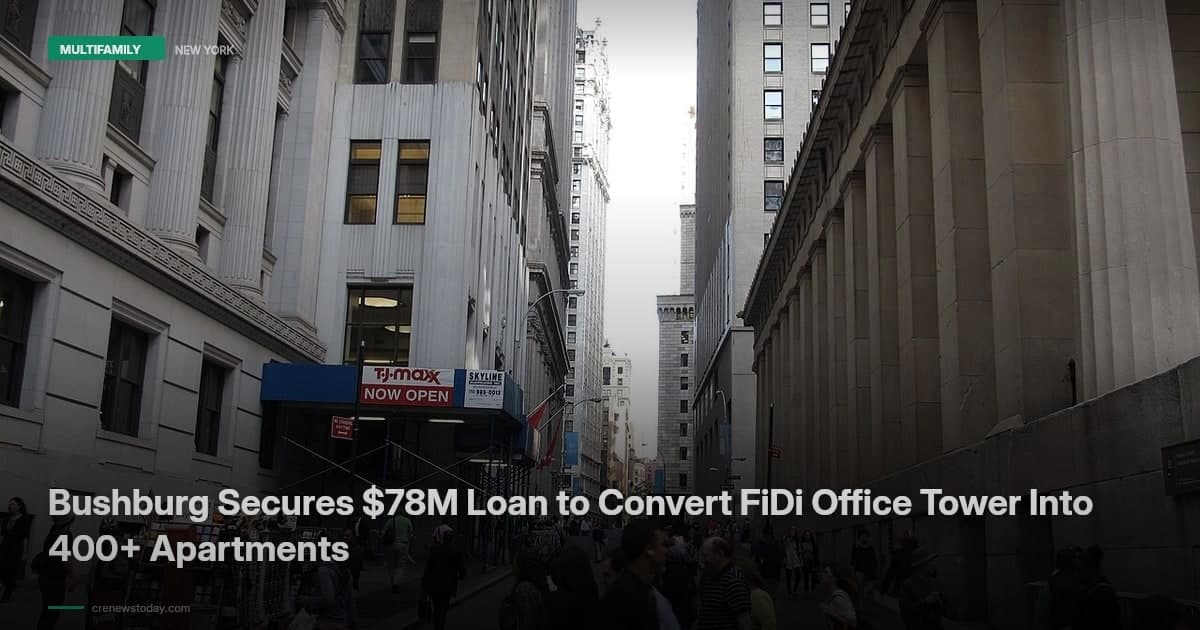
A 21-story office building in Manhattan's Financial District is set to become the latest addition to New York City's growing pipeline of office-to-residential conversions after Bushburg Properties secured $78 million in acquisition and pre-development financing.
The Deal
Oak Funding and OakNorth Bank provided the co-loan for Bushburg's acquisition of 100 William Street, a roughly 400,000-square-foot Class A office tower near Fulton Street Station. The building was approximately half vacant at the time of purchase.
Bushburg acquired the property from Manulife Financial Corporation for $70 million — less than half the $167 million the Canadian insurance giant paid 12 years earlier. The steep discount reflects the continued repricing of older Manhattan office product in the post-pandemic market.
Conversion Plans
Bushburg plans to convert the 1970s-era tower into more than 400 apartments, with 25% designated as affordable housing under income restrictions. The project is currently in the pre-development phase.
The firm is no stranger to large-scale conversions. Bushburg is already underway on one of the city's largest adaptive-reuse projects at 80 Pine Street, where it is converting a former office building into more than 700 apartments.
Founded in 1999 by Joseph Hoffman, Bushburg has accumulated a portfolio of over $4 billion in assets spanning more than 9 million square feet across New York City and New Jersey.
NYC Conversion Boom
The 100 William Street project joins a rapidly expanding conversion pipeline across lower Manhattan. Annual office-to-residential conversion volume has grown from less than 1.2 million square feet before 2020 to 4.1 million square feet as of mid-2025, with another 8.8 million square feet in the pipeline across 25 properties.
The Financial District has been a particular hotspot. Other notable FiDi conversions include 25 Water Street (1,320 luxury units), 101 Greenwich Street (614 units planned), Pearl House (588 units), and 55 Broad Street (571 units).
Policy tailwinds continue to support conversions, including the city's Office Conversion Accelerator Program, the 467-m tax incentive offering up to 35 years of tax relief for projects with affordable housing, and the City of Yes zoning reform that lifted the 12 FAR cap. An estimated 14,500 apartments across 12.2 million square feet could begin renovation by mid-2026.
Related coverage: Jonathan Rose Companies Expands NYC Affordable Housing Portfolio with $53M Inwood Acquisition · Winchester Partners Deliver 283-Unit Mixed-Income Community in New Haven's $92.5M Science Park Revival · Hudson Valley Property Group Secures 387-Unit Elk Grove Community for $83.6M
What the Loan Does—and Does Not—Prove
The $78 million commitment shows that lenders will fund a conversion when the sponsor, basis, and redevelopment plan meet their standards. It does not remove the construction and lease-up risks that make these projects difficult. Investors should watch final unit count, affordable-housing requirements, construction draws, and the delivery schedule before comparing this project with a conventional apartment acquisition.
The most important operating test will come after completion. More than 400 homes can create meaningful residential density, but their performance will depend on effective rents, concessions, and the cost of adapting an office floorplate to residential use. The broader FiDi pipeline also raises a timing question: many conversions may benefit the neighborhood while competing for tenants if they deliver at once.
CRE News Briefing Coming Soon
Until it launches, send press releases, story ideas, and sponsorship inquiries directly to the newsroom.
Free CRE News Briefing
Editor-curated commercial real estate stories, delivered to your inbox. Confirm your email to join.