Phoenix water-meter assumptions can move a development budget by six figures

Original analysis | Phoenix development
A water-meter assumption can conceal a substantial gap in a Phoenix development budget. CRE News Today's comparison of two entries in the city's posted schedule produces a $391,299 difference across five fee categories for one hypothetical nonresidential meter in the Northwest (Off-Project) area.
That is a comparison of listed assessments, not an estimate for an identified property. The useful question for a buyer, developer or lender is whether the project's service assumptions have been confirmed before its budget becomes a purchase price, loan request or tenant commitment.
One area, two meter assumptions
We reviewed the city's schedules on October 22. Its 2025 impact-fee update page identifies June 23, 2025 as the effective date. This analysis does not report a newly announced increase.
The comparison below uses the Northwest (Off-Project) column and the nonresidential two-inch and three-inch meter rows in the city's net-assessment schedule. It includes only these five water and wastewater categories; all amounts are dollars.
| Category | 2-inch | 3-inch | Difference |
|---|---|---|---|
| Wastewater collection | $33,569 | $104,860 | $71,291 |
| Wastewater treatment | $24,573 | $76,758 | $52,185 |
| Water transmission | $86,653 | $270,678 | $184,025 |
| Water treatment | $27,064 | $84,541 | $57,477 |
| Water resource acquisition | $12,394 | $38,715 | $26,321 |
| Five-category subtotal | $184,253 | $575,552 | $391,299 |
Source: City of Phoenix schedule, pages 2 and 3. Subtotals and differences calculated by CRE News Today. These are not complete project fees or the cost of installing a meter.
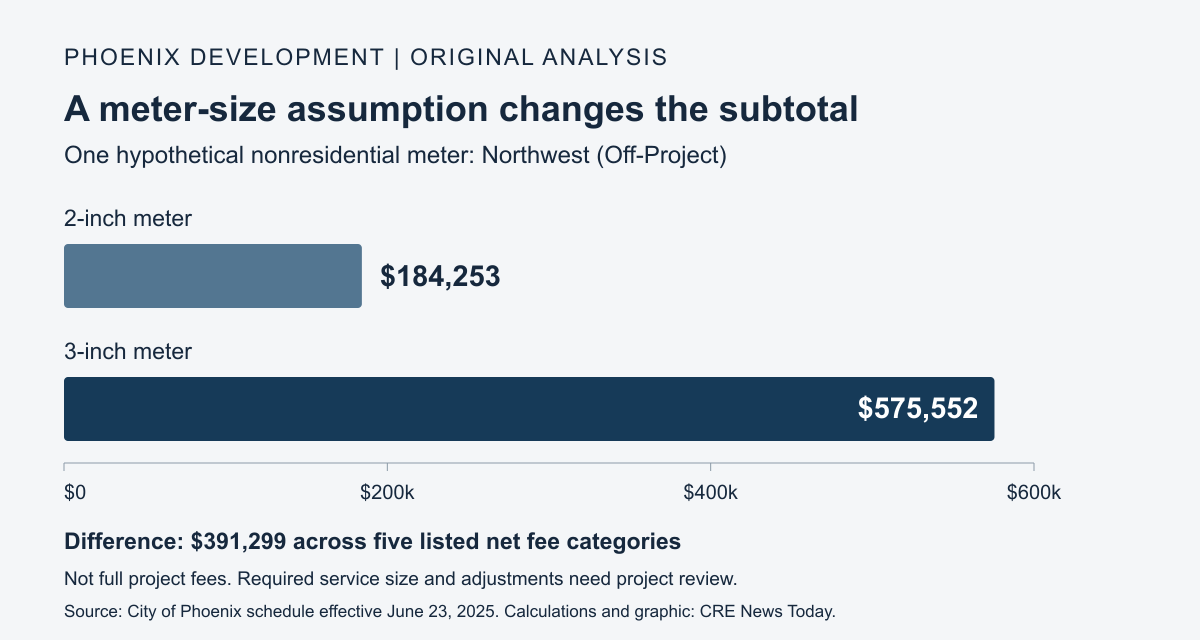
Graphic: CRE News Today, using the city schedule. The bars start at zero. Engineering requirements and project-specific adjustments remain unresolved in this example.
The arithmetic is a sensitivity test, not a recommendation to use a smaller meter. The required service must be established through the project's engineering and city review. A lower spreadsheet allowance does not make a smaller service suitable.
Confirm the geography before copying a number
The city's approved impact-fee report describes different service-area groupings for different infrastructure programs. Its assessment framework uses equivalent demand units and applicable factors, with adjustments for qualifying fund balances and alternative revenue offsets.
For underwriting, that means a Phoenix mailing address is an incomplete fee assumption. Record the parcel, applicable area, project use and service configuration together. Do not carry the Northwest example into a different location merely because the proposed building looks similar.
An acquisition file should distinguish confirmed facts from placeholders. A seller's historic utility bill may help start the investigation, but it does not establish the assessment for the buyer's proposed development. If the business plan changes, ask whether the previous estimate still describes the project.
Keep the fee estimate and construction budget separate
Phoenix's development finance overview identifies several distinct charges and programs, including water-resource acquisition, meter and tap work, and sewer connections. It also describes potential credits for eligible developer-financed infrastructure and repayment agreements for certain oversized facilities.
Those programs do not establish a credit or reimbursement for this hypothetical project. Keep an unapproved recovery out of the base budget. If a project team expects one, identify the applicable agreement, eligible work and approval evidence before treating it as money available to close a funding gap.
The city separately explains that development occupational fees offset gross impact fees. Because the table above already uses published net assessments, do not subtract a presumed offset again or mechanically add another schedule to it. Ask the city to reconcile the categories in the project's written estimate.
For an existing building, also establish what service is already in place and how the proposed work changes it. This example does not calculate an upsizing charge, establish a credit for existing service or determine whether a particular renovation triggers an assessment.
Request an estimate that another person can reproduce
Phoenix's commercial impact-fee estimate instructions direct applicants to send project information to impactfees@phoenix.gov. Requested details include planned use, address or parcel information, acreage, building size and water-meter type and size, plus dwelling units where applicable.
Our suggested underwriting handoff adds four checks:
- Attach the assumptions. Keep the site plan and service information used for the request with the response. Mark uncertain inputs so an estimator does not mistake them for approved engineering.
- Identify what is included. Ask which assessments, credits and separate connection or construction costs the response covers. Retain the category breakdown, rather than copying only a total.
- Date the evidence. Record the response date, applicable schedule and any stated conditions. Ask when a design revision or delay requires a refreshed estimate.
- Assign the unresolved risk. Before making a binding project commitment, decide who will verify the remaining inputs and who carries any resulting cost under the transaction documents.
A provisional meter size can be useful during screening if it stays visible as an assumption. Once the project advances, replace it with documented service requirements and a reconciled estimate. That makes the budget easier to defend and prevents a seemingly small utility detail from becoming an unexplained financing gap.
Related reading: Craig Hoebing's five checks before an Arizona CRE loan matures. For future local analysis, subscribe to CRE News Today.
Method: Original desk analysis of public City of Phoenix documents, reviewed October 22, 2026. No property-specific estimate, engineering review or interview is represented. The photograph is illustrative. Source photograph, Robert693, with source crop by LivinAWestLife and additional crop and toning by CRE News Today; the adapted photograph is distributed under CC BY-SA 4.0.
Free CRE News Briefing
Editor-curated commercial real estate stories, delivered to your inbox. Confirm your email to join.