Two CRE Debt Transactions, Two Different Risk Structures
What Greybarn Amityville and MetLife’s opportunistic debt fund teach about credit risk
The headline numbers measure different things
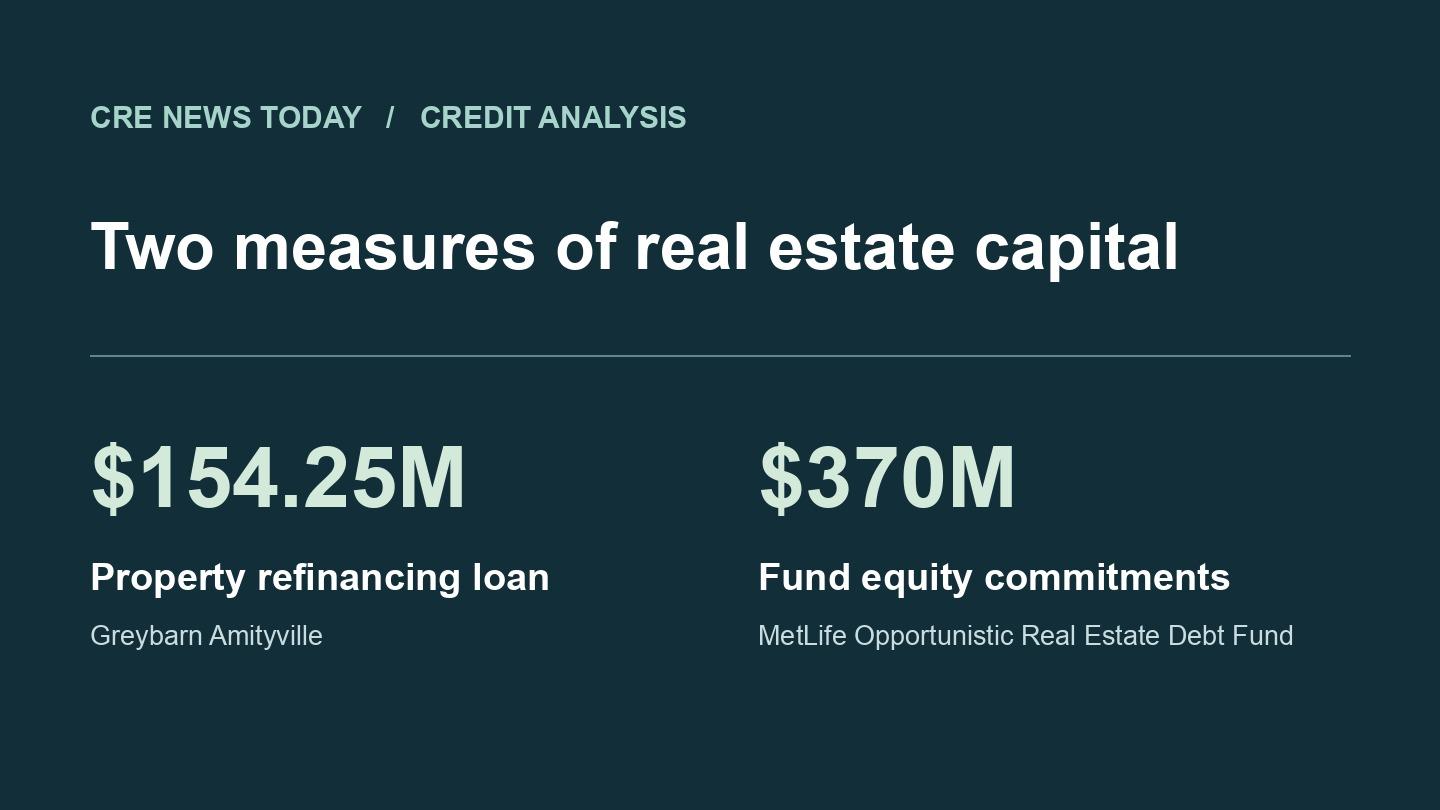
Two commercial real estate financing announcements offer a useful lesson in how credit risk changes with the level of analysis. JLL reported a $154.25 million refinancing loan for Greybarn Amityville, with PCCP providing financing to Rechler Equity Partners. MetLife Investment Management announced $370 million in total equity commitments to its MetLife Opportunistic Real Estate Debt Fund (MORE). These are not competing measures of loan volume or property value. The first is a loan tied to an identified asset; the second is capital committed by investors to a vehicle that plans to invest in real estate loans. A fund may call commitments over time, and the announcement does not establish how much has been drawn, invested, or borrowed at the fund level. This distinction must precede any comparison of leverage or performance.
What the property announcement establishes
According to JLL, Greybarn Amityville at 805 Broadway in Amityville, New York, comprises 335 apartments, including 269 market-rate and 66 workforce units, plus 37,737 square feet of ground-floor retail. Rechler developed the property in three phases from 2016 to 2020. JLL characterizes it as fully stabilized. PCCP is the lender and JLL arranged the refinancing. The announcement does not provide the appraised property value, net operating income (NOI), annual debt service, loan pricing, amortization, or maturity. Without those variables, neither actual loan-to-value (LTV) nor debt-service coverage ratio (DSCR) can be calculated. Stabilization and a constrained local supply pipeline are relevant context, not substitutes for cash-flow underwriting.
Illustrative leverage and coverage tests
LTV equals loan principal divided by collateral value. Holding the announced $154.25 million loan amount constant, a hypothetical $250 million valuation implies 61.7% LTV; $225 million implies 68.6%; and $200 million implies 77.1%. These valuations are invented solely to show sensitivity and are not estimates of Greybarn’s actual value. A lender’s apparent collateral cushion can narrow when value declines even if principal is unchanged. DSCR equals NOI divided by required annual debt service. In a separate hypothetical example, $14 million NOI and $11 million debt service yield a 1.27 DSCR. A 10% NOI decline reduces coverage to 1.15; a 20% decline reduces it to 1.02. These cash flows are not Greybarn disclosures. Floating-rate exposure, reserves, loan covenants, and maturity risk would require additional information. The point is not that Greybarn is stressed, but that headline financing size cannot answer whether its debt remains serviceable under downside conditions.
What the fund announcement establishes
MetLife states that MORE is a closed-end fund pursuing transitional commercial real estate opportunities across the United States, including senior and subordinate secured lending, with emphasis on multifamily, industrial, and selected other property types. Its borrowers may seek capital for refinancing, repositioning, business plans, or market dislocations. The $370 million is total equity commitments from institutional investors, not a $370 million loan to a single borrower and not proof of $370 million in outstanding originations. The announcement does not provide a complete investment schedule, drawn capital, loan-level leverage, portfolio concentrations, fund borrowing, liquidity terms, or realized returns. It would be inappropriate to invent those figures.
Diversification does not remove concentration
A fund-level investor must analyze each loan and the portfolio assembled from those loans. Consider two purely hypothetical $100 million portfolios. One holds ten $10 million loans; the other holds loans of $40 million, $25 million, $25 million, and $10 million. The largest individual exposure is 10% in the first and 40% in the second. A total principal loss on the largest exposure would therefore have a very different portfolio impact before considering recoveries. Yet even ten loans may be correlated if they share a region, refinancing window, sponsor, or property sector. Loan count alone does not prove diversification. Fund-level diligence also considers unfunded commitments, capital calls, fees, borrowing facilities, and investment pacing.
Loss priority matters as much as property value
MetLife’s stated ability to originate or invest in both senior and subordinate secured loans makes contractual priority central. Imagine an entirely hypothetical property worth $100 million, financed by $65 million senior debt, $15 million subordinate debt, and $20 million equity. If net realizable proceeds fall to $70 million, and if the senior claim is paid first with no other claims or expenses, the senior lender recovers $65 million, the subordinate lender recovers $5 million and loses $10 million, and the equity holder receives nothing. This is a simplified waterfall, not an actual MORE investment or a prediction. Real recovery depends on security interests, intercreditor provisions, accrued obligations, expenses, enforcement, and law. The lesson is that a 30% collateral-value decline does not impose the same percentage loss on every capital layer.
A comparison that does not imply a winner
At the Greybarn property level, the immediate analytical questions are collateral value, NOI resilience, debt service, maturity, and sponsor support. At the MORE fund level, an investor needs those same loan-level answers plus the distribution of risk across borrowers, collateral, regions, seniority positions, and fund financing. It would be misleading to compare the $154.25 million loan directly with the $370 million in equity commitments as though both were outstanding secured debt. Neither public release contains sufficient data to conclude that one is safer, more leveraged, or more profitable than the other. Both are useful examples precisely because they force the reader to ask what the reported number measures.
Five practical questions for readers
First, is the announced amount a loan balance, property valuation, fund commitment, or invested capital? Second, which cash flows are legally available to service the obligation? Third, what happens to coverage and collateral protection if income or values fall? Fourth, where does each lender sit in the enforceable payment waterfall? Fifth, what information remains undisclosed, and what assumptions have been introduced by the analyst? The discipline of separating transaction facts from illustrative scenarios is more informative than drawing a risk conclusion from a headline amount alone.
Conclusion
The Greybarn refinancing illustrates analysis centered on one property and its loan. MORE illustrates the additional questions that arise when investors commit equity to a fund that holds debt investments. Scale is visible in both announcements; underwriting quality is not. Responsible credit analysis begins by defining the capital, locating the collateral and cash flows, testing adverse conditions, and acknowledging what public information cannot establish.
Primary announcements
JLL, “JLL arranges $154.25M refinancing for Greybarn Amityville on Long Island” (web release dated November 20, 2026): https://www.jll.com/en-us/newsroom/jll-arranges-154-25m-refinancing-for-greybarn-amityville
MetLife, “MetLife Investment Management Closes $370 Million Opportunistic Real Estate Debt Fund” (November 17, 2026): https://www.metlife.com/about-us/newsroom/2026/november/metlife-investment-management-closes-370-million-opportunistic-real-estate-debt-fund/
Author biography
Sri Harsha Chakrapani is an engineering and risk-analysis professional with a master’s degree in Engineering Management from Pennsylvania State University. Through CRE Risk Desk, he develops educational analysis of commercial real estate underwriting, leverage, debt-service coverage, and scenario-based risk.
Disclosure
The author reports no financial, employment, advisory, or other material relationship with PCCP, Rechler Equity Partners, JLL, MetLife Investment Management, or the transactions discussed.
This independent educational article uses publicly available announcements. All numerical stress tests and loss scenarios are hypothetical, not actual underwriting or forecasts. It is not investment advice.
Free CRE News Briefing
Editor-curated commercial real estate stories, delivered to your inbox. Confirm your email to join.