Interest-only CRE loans: the payment relief and the maturity bill

A lower monthly loan payment can make a commercial property easier to hold while leases turn over or construction finishes. It can also leave a larger refinancing problem at maturity. The missing question in many comparisons is what the owner does with the cash that principal payments would otherwise consume.
Interest-only financing can preserve liquidity for a business plan. That benefit is different from reducing debt. A useful comparison puts the payment schedule, remaining loan balance and available cash on the same timeline, then tests a replacement loan that is smaller than expected.
Separate the loan term from its amortization
The term is the time until the loan matures. Amortization describes the schedule used to repay principal through regular installments. A five-year loan with payments calculated over 25 years still has a substantial balance due after five years. The longer schedule does not give the borrower another 20 years automatically.
Under a fully interest-only schedule, regular payments cover interest and scheduled principal remains unchanged. This differs from negative amortization, where unpaid interest can increase the balance. Actual documents may also require principal reductions, cash sweeps or reserves that change the simple comparison below.
The Office of the Comptroller of the Currency's refinance-risk bulletin directs banks to assess repayment at origination and through maturity. Its practical implication for owners is straightforward: keeping current on today's payments does not establish that tomorrow's lender will refinance the remaining debt.
A $5 million comparison, with the assumptions visible
Consider three hypothetical structures: $5 million borrowed for five years at a fixed 6.5% annual rate, with either interest-only payments, 30-year amortization or 25-year amortization. Payments occur monthly in arrears. The calculation uses the annual rate divided by 12, with 60 payments before the remaining balance is repaid at maturity.
The rate is an illustration, not a current lender quote. All three structures have identical starting principal and interest rates solely to isolate amortization. Fees, default charges, reserves, taxes, prepayment costs and interest on retained cash are excluded. Figures are rounded after calculation; lender day-count conventions and payment dates can produce different results.
| Payment structure | Monthly payment | Balance after 60 payments | Principal repaid |
|---|---|---|---|
| Interest-only | $27,083 | $5,000,000 | $0 |
| 30-year amortization | $31,603 | $4,680,549 | $319,451 |
| 25-year amortization | $33,760 | $4,528,108 | $471,892 |
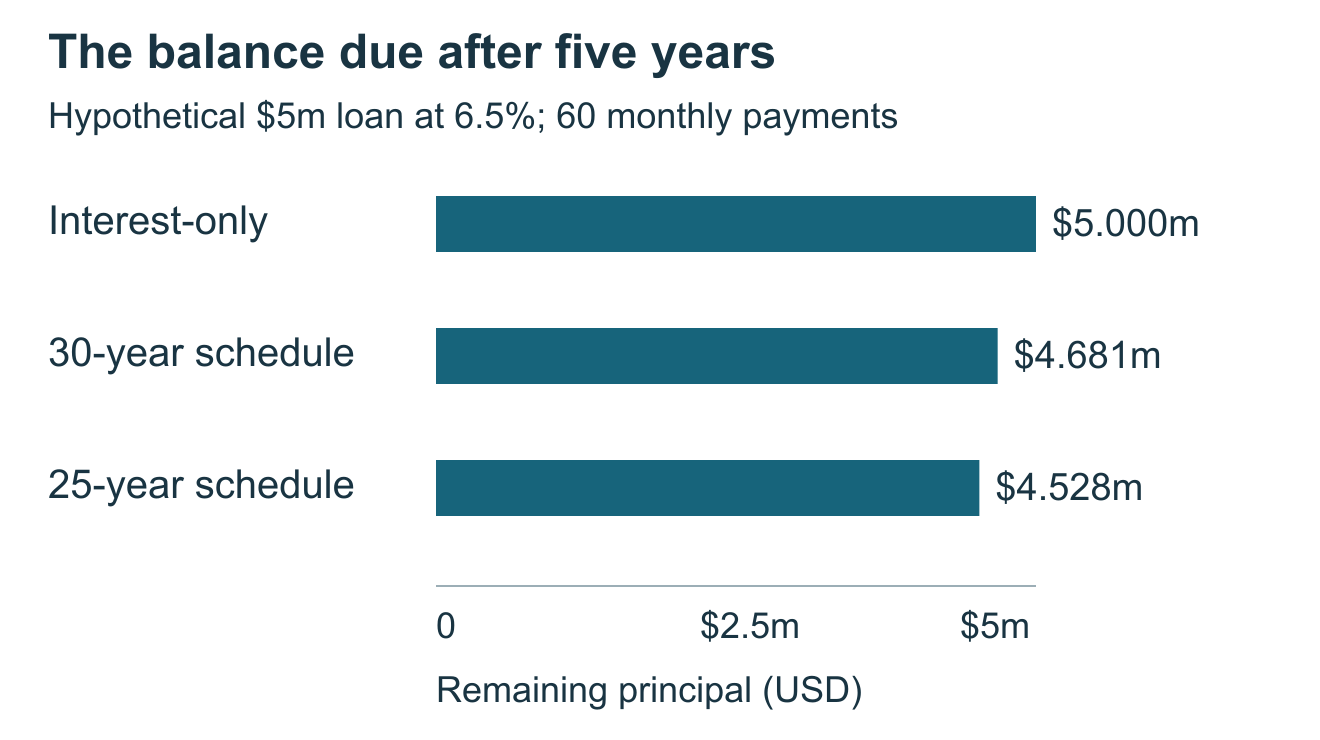
Graphic: CRE News Today calculations. Identical $5 million starting loans and assumed 6.5% fixed rate. Balances follow the 60th scheduled payment and precede the balloon payoff. These are scenarios, not observed transactions.
The interest-only structure requires about $6,677 less each month than 25-year amortization. Over 60 months, that is about $400,621 in payment cash retained, but $471,892 more principal outstanding. Those two amounts are different because paying principal earlier also reduces later interest.
Total five-year interest is $1,625,000 under interest-only, compared with approximately $1,553,730 under 25-year amortization. The roughly $71,270 difference explains why saving every dollar of payment relief still does not fully offset the larger balance in this no-return example. It does not establish which structure produces a better investment return.
Test the gap before assuming a refinance
Suppose a replacement lender will advance $4.4 million at maturity and transaction costs require another $50,000. These are additional assumptions, not lending standards. The owner must fund the old balance plus costs less the replacement proceeds.
That produces a gross cash requirement of $650,000 for interest-only, about $330,549 for 30-year amortization and about $178,108 for 25-year amortization. This is a funding-gap calculation, separate from whether the property supports the replacement loan's payments.
Now assume the interest-only borrower actually retained the entire $400,621 payment difference against the 25-year schedule in accessible cash. Applying it at closing leaves about $249,379 still needed. That is around $71,270 more than the amortizing borrower's $178,108 requirement, consistent with the interest difference above.
If the cash was distributed to investors, it is no longer available to the borrowing entity unless returned. If it funded improvements, its value depends on the resulting income, valuation and lender treatment. A dollar spent on a renovation is not automatically a dollar of additional refinancing proceeds.
Check where the flexibility goes
For an owner comparing term sheets, the useful questions extend beyond the quoted payment:
- Does interest-only last for the full term? A temporary period followed by amortization creates a payment increase before maturity. Model that exact transition.
- Can the borrower retain the cash? A lender-controlled reserve or sweep may restrict distributions and uses. Count only cash that can actually fund the intended business plan or payoff.
- What changes in the downside case? Test lower refinance proceeds alongside leasing costs and near-term capital needs. Avoid using the same cash reserve twice for separate obligations.
- Who can supply a shortfall? Identify the entity with available funds, the conditions for a capital call and the timing needed to move money before closing.
An extension is a separate decision with its own conditions. The interagency policy on prudent CRE accommodations and workouts encourages constructive lender engagement and review of repayment capacity. It does not give a borrower an automatic extension or an unconditional refinancing commitment.
Craig Hoebing's five checks before an Arizona CRE loan matures provides a complementary checklist for preparing the actual transaction. This comparison supplies a narrower test: compare payment relief with debt reduction, then show where the retained cash will be when the maturity bill arrives.
Method: Original CRE News Today analysis using standard monthly amortization formulas and an independent month-by-month balance check. The examples describe no actual borrower, lender offer or transaction. They omit property-level returns and tax effects and do not rank the structures for a particular investment.
Free CRE News Briefing
Editor-curated commercial real estate stories, delivered to your inbox. Confirm your email to join.