Phoenix tenant improvements need an occupancy plan before the lease clock starts

Original analysis | Phoenix commercial leasing
A Phoenix landlord and prospective tenant can agree on rent, an improvement allowance and a delivery date while leaving the most consequential scheduling question unresolved: what has to happen before the business can occupy the space?
The city’s current commercial guidance separates the work authorization from the inspections and occupancy outcome. Treating them as one milestone can leave a tenant paying for premises it cannot yet use, or leave an owner waiting for rent that its leasing model assumed would already be collected.
Phoenix’s commercial and multifamily building page says commercial permits cover tenant improvements and changes of use, among other work. It also directs new commercial plan-review and inspections permits to SHAPE PHX effective April 27, 2026. That portal change is useful context for a new application, but it is not evidence that an individual space is cleared to open.
For an owner evaluating a retail or office prospect, the practical task is to connect the intended use, the construction scope, the city’s required milestones and the lease’s payment dates before committing to an opening assumption.
Start with the premises and the proposed operation
Phoenix’s Certificate of Occupancy guidance lists newly occupied tenant improvements and improvements or remodels involving an occupancy-type change among projects requiring a certificate. It also recognizes projects that do not require a new certificate. The property team should establish the applicable path rather than assume every tenant turnover produces the same paperwork.
Begin with the existing permit and occupancy record for the actual suite, then describe the intended operation to the project’s design professionals and city staff. A prior tenant’s use is background information. It does not, by itself, establish the requirements for a different operation or scope of construction.
The city provides an occupancy-certificate search and a public-records-request route. Keep the records with the lease diligence file, including the premises description and any questions that remain unresolved. A missing search result should prompt further inquiry, not a conclusion that the space is automatically acceptable or unusable.
Give the schedule more than one completion box
The city’s commercial process overview makes a useful distinction: new commercial projects require preliminary site-plan approval before building-plan review, while a tenant improvement may not have site issues. An existing suite and a new building should not automatically inherit the same approval schedule.
For the selected path, assemble a short milestone register. It should identify the scope and responsible professional; submission and correction responsibilities; permit issuance; construction delivery; required inspections and correction work; and the occupancy documentation applicable to the project. Ask the team to confirm which steps apply to the particular space.
Phoenix’s commercial inspections page says permits are not finalized until required inspections are conducted and construction is approved. It also says required inspections and construction approval precede permanent occupancy, with a certificate issued when required or a green tag otherwise. A failed inspection requires the identified issues to be resolved and a reinspection requested.
That gives the leasing team a concrete question: which event does the contract call “complete,” and which document or approval demonstrates it? Construction delivery, the end of a free-rent period and operational readiness can fall on different dates. Counsel and the project team should translate those distinctions into the transaction’s actual language and obligations.
Price the cash exposure explicitly
Consider a hypothetical 3,000-square-foot premises. Assume annual base rent of $32 per square foot, budgeted additional charges of $7 per square foot annually, and $4,500 of other fixed monthly pre-opening overhead. These are invented modeling inputs, not a Phoenix rent survey or an estimate of city fees.
If all three charges are payable during the period being tested, the arithmetic is:
- Base rent: 3,000 multiplied by $32, divided by 12, equals $8,000 monthly.
- Budgeted additional charges: 3,000 multiplied by $7, divided by 12, equals $1,750 monthly.
- Combined cash requirement: $8,000 plus $1,750 plus $4,500 equals $14,250 monthly.
Using simplified 30-day months, an additional 30 days before opening consumes $14,250. An additional 60 days consumes $28,500. These are sensitivity cases, not predictions of permit or inspection delays. The example excludes improvement spending, financing costs and lost sales, and assumes no offsetting operating receipts during that period.
The lease can change the allocation substantially. If base rent is not yet due, remove it from the tenant’s cash calculation for that period. If the owner’s rent commencement is deferred, separately model the owner’s foregone base-rent receipts and its own expenses. Do not add the tenant’s rent payment and the owner’s corresponding rent receipt as though they were two independent economic losses.
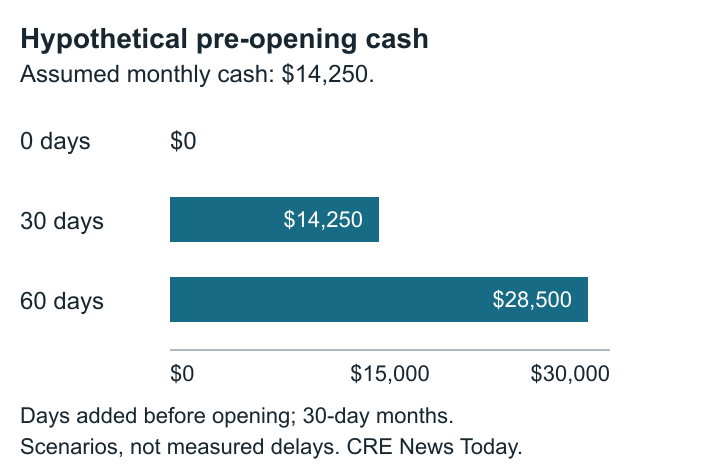
Graphic: CRE News Today. Hypothetical sensitivity using 30-day months and the stated $14,250 monthly cash requirement; no observed city delay or processing-time estimate is depicted.
The value of this exercise is identifying who needs liquidity and when. A tenant-improvement allowance alone does not answer that question.
Make the handoff specific before signing
A useful diligence conversation should leave both sides able to answer five questions:
- What use and construction scope are being assessed, and which existing suite records support the discussion?
- Who owns each submission, correction and inspection request, including coordination among trades and the owner’s work?
- Which city approvals or completion documents apply before the planned occupancy, and who confirms they have been obtained?
- Which lease events trigger delivery acceptance, rent commencement and any opening obligation, and how are unresolved work or approval issues addressed?
- What cash reserve covers a later opening under the negotiated allocation of costs?
Those questions do not replace a project-specific permit determination or a negotiated lease. They give the owner, tenant, broker and advisers a shared set of facts to resolve. A tentative target date can then be distinguished from a contractual obligation and a required city milestone.
Phoenix’s public process pages explain the sequence; they do not establish a processing-time distribution for this article’s hypothetical project. This analysis makes no claim that Phoenix approvals usually take an additional 30 or 60 days, or that a portal filing guarantees an opening date. The underwriting improvement is to expose the timing dependency and fund it explicitly.
Related reading: South Mountain and Laveen retail plans and five checks before an Arizona CRE loan matures.
Method and image note: CRE News Today reviewed the linked City of Phoenix guidance on October 29, 2026. This is public-document analysis with original hypothetical calculations, not an interview, observed project case or city processing-time study. The photograph is an archival illustration. Its CC BY-SA 4.0 license applies to the adapted photograph.
Free CRE News Briefing
Editor-curated commercial real estate stories, delivered to your inbox. Confirm your email to join.